
The Fool's Journey
The Fool's Journey is a narrative framework for understanding the 22 Major Arcana cards as a single, continuous story of personal growth and spiritual evolution. Each card represents a stage, a lesson, or a transformation that The Fool — representing each of us — encounters on the path from innocence to wholeness.
The Fool
Card 1 of 22

Our story begins with The Fool — a young soul standing at the very edge of a cliff, one foot lifted as if about to step into the void. A small knapsack dangles from a stick over one shoulder (carrying only the bare essentials of experience), and in one hand they hold a white rose, the symbol of pure desire untainted by worldly knowledge. A small white dog leaps at their heels — some say it is their instincts trying to warn them, others say it is their faithful companion, urging them forward.
The Fool gazes upward at the bright sun rather than down at the precipice below. This is not ignorance — it is trust. The Fool represents the soul before its journey through life: full of infinite potential but without form or direction. Every person begins here, at the threshold of the unknown, carrying nothing but faith and openness.
In the Rider-Waite-Smith deck, The Fool is numbered 0 — not the first card, but the card that exists outside the sequence. Zero is the number of unlimited possibility. The Fool is both the beginning and the end, the eternal traveler who will walk through every experience the Major Arcana has to offer and emerge transformed.
And so, with a light heart and trusting spirit, The Fool takes that step off the cliff — and the journey begins.
The Magician
Card 2 of 22
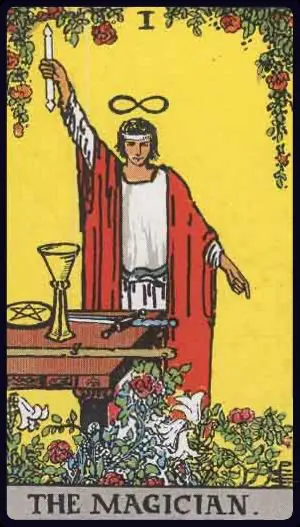
The Fool's first encounter is with The Magician — a figure of power and focus who stands before a table bearing the tools of all four suits: a wand, a cup, a sword, and a pentacle. These represent the four elements (fire, water, air, earth) and all the resources available in the material and spiritual worlds. One hand points toward the heavens, the other toward the earth, channeling cosmic energy into physical reality. Above the Magician's head floats the lemniscate — the infinity symbol — showing that this power is limitless.
The Fool is dazzled. Here is someone who has learned to take raw potential and shape it into something real. The Magician teaches The Fool the first great lesson: you have everything you need within you. Willpower, focus, and skill can transform the invisible into the visible. But The Magician also carries a warning — this same power can be used for manipulation and trickery. The Fool must learn to wield it with integrity.
Roses and lilies grow at The Magician's feet, symbolizing the union of desire and purity. The Fool leaves this encounter with a spark of confidence — the knowledge that they are capable of creating their own reality. But knowing you can do something and knowing what to do with that power are very different things. The journey continues.
The High Priestess
Card 3 of 22
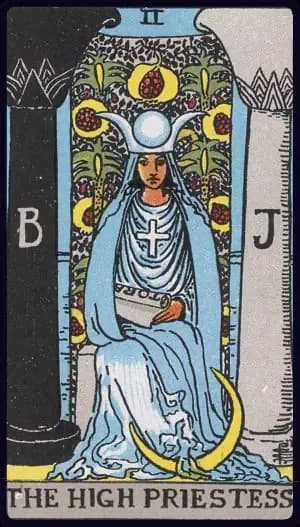
If The Magician represents conscious power and outward action, The High Priestess is his perfect counterpart — the guardian of the subconscious, inner wisdom, and hidden knowledge. The Fool encounters a serene, veiled woman seated between two pillars: one black (labeled B, for Boaz) and one white (labeled J, for Jachin), evoking the pillars that stood at the entrance of Solomon's Temple. She holds a scroll partially concealed in her robes, labeled TORA, representing the deeper laws of the universe that cannot be grasped through intellect alone. A crescent moon rests at her feet.
Behind her hangs a veil decorated with pomegranates — a symbol of fertility and the hidden depths of the feminine divine. Beyond that veil lies the sea of the subconscious, the great reservoir of memory, dream, and intuition that lies beneath conscious awareness.
The High Priestess does not speak in plain words. She teaches The Fool through silence, through feeling, through the quiet knowing that arrives not from thinking but from listening. Her lesson is profound: not everything can be understood through action and logic. Some truths can only be accessed by going inward, trusting your intuition, and being still enough to hear the whispers of the soul. The Fool, who has just learned about outer power from The Magician, now discovers that an equally vast world exists within.
The Empress
Card 4 of 22
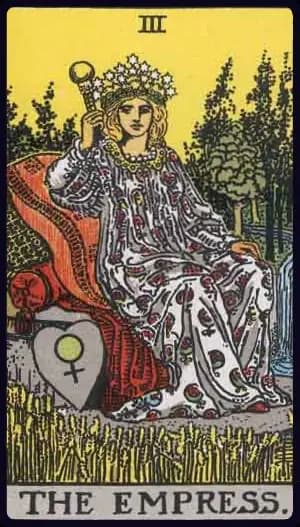
Emerging from the contemplative stillness of The High Priestess, The Fool enters a lush, abundant garden and encounters The Empress — a radiant woman reclining on plush cushions amid a field of golden wheat. She wears a crown of twelve stars (representing the twelve months and the zodiac), and her flowing robe is adorned with pomegranates. A heart-shaped shield bearing the symbol of Venus rests nearby, and a river winds through the verdant landscape behind her.
The Empress is the Great Mother — the embodiment of nature, fertility, sensuality, and unconditional love. She creates and nourishes. Where The Magician shapes reality through will, The Empress brings forth life through love. She teaches The Fool about the power of nurturing, the beauty of the physical world, and the importance of connecting with nature and the body.
In her garden, everything grows freely. She shows The Fool that creativity does not always need discipline and structure — sometimes it needs warmth, patience, and a willingness to let things unfold in their own time. The Empress tells The Fool: "You are worthy of abundance. The world wants to give to you as much as you want to give to it."
The Fool feels deeply nourished and connected to the sensory world. But this garden of ease cannot last forever. There is still structure to learn, and the next encounter will be very different.
The Emperor
Card 5 of 22
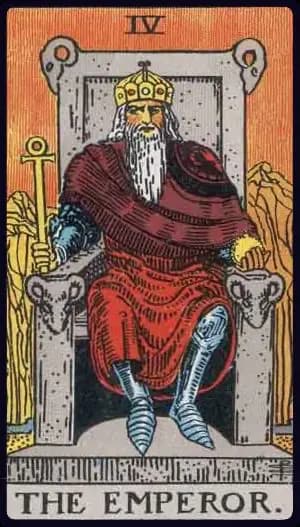
From the abundant garden, The Fool comes upon a figure seated on a great stone throne in an austere, mountainous landscape. This is The Emperor — an armored ruler whose throne is carved with four rams' heads, the symbol of Aries, the sign of leadership and assertive action. He holds an ankh scepter (symbol of life) and an orb (symbol of dominion). The barren mountains behind him suggest he has mastered even the harshest terrain through pure force of will.
Where The Empress nurtured through love and patience, The Emperor builds through authority and structure. He is the architect of civilization, the creator of laws, the protector of boundaries. His lesson to The Fool is essential: freedom without structure is chaos. Creativity without discipline is wasted potential. To build something lasting in the world, you need rules, planning, and the willingness to enforce order — even when it's uncomfortable.
The Emperor is not gentle, but he is fair. He represents the father principle — the part of us that provides safety, sets clear expectations, and holds firm boundaries. The Fool learns that true authority is not about control for its own sake, but about creating the conditions in which others can thrive.
But The Fool also begins to sense that rigid authority has limitations. Rules and structure are necessary, but they are not the whole picture. Something deeper is needed — a moral and spiritual foundation. The next encounter will provide exactly that.
The Hierophant
Card 6 of 22
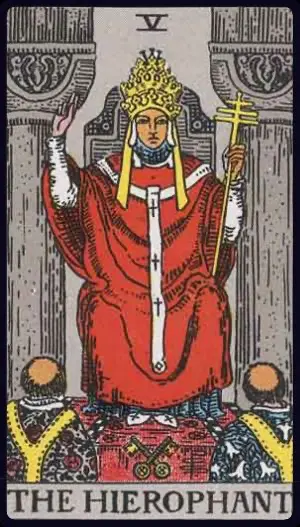
The Fool now encounters The Hierophant — a spiritual authority figure seated between two gray pillars, wearing elaborate vestments and a triple-tiered crown. He raises his right hand in a gesture of benediction, two fingers pointing up and two pointing down, connecting heaven and earth. Two acolytes kneel before him, and two crossed keys lie at his feet — the keys to sacred knowledge and worldly knowledge.
The Hierophant represents tradition, organized spiritual wisdom, and the teachings that have been passed down through generations. While The High Priestess taught The Fool to seek insight from within, The Hierophant teaches that there is great value in external traditions — in the accumulated wisdom of communities, religions, philosophies, and mentors.
The Fool learns about ritual, ceremony, and the importance of shared belief systems. Not all knowledge needs to be discovered alone. Sometimes the fastest way to grow is to learn from those who have walked the path before you. The Hierophant offers The Fool a framework — a map of meaning that makes the vast cosmos a little more navigable.
But the Hierophant also carries a shadow: blind conformity, rigid dogma, and the suppression of independent thought. The Fool must eventually learn to honor tradition without being imprisoned by it — to take what serves growth and leave behind what limits it. With this foundation of both inner wisdom (The High Priestess) and outer teaching (The Hierophant), The Fool is ready for the next great challenge: choice.
The Lovers
Card 7 of 22
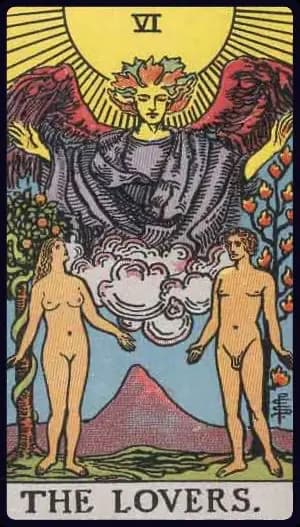
The Fool arrives at a fateful crossroads and encounters The Lovers — a scene of breathtaking beauty and consequence. A naked man and woman stand beneath a great angel with outstretched violet wings, reminiscent of the archangel Raphael. Behind the woman grows the Tree of Knowledge, bearing fruit with a serpent coiled around its trunk. Behind the man stands the Tree of Life, blazing with twelve flames. A volcanic mountain rises in the background, hinting at the powerful forces beneath the surface.
This is not merely a card about romantic love (though it includes that). The Lovers represents the fundamental human experience of choice — the moment when The Fool must decide between competing values, desires, and paths. Until now, The Fool has been absorbing lessons passively. Now, for the first time, they must choose.
Waite deliberately redesigned this card from its earlier Italian versions (which showed a clothed couple receiving a blessing from a noble) to depict Adam and Eve in the Garden of Eden, reinforcing the card's correspondence with Gemini — the sign of duality and communication. The angel above represents the higher self, offering guidance, but the choice belongs to The Fool alone.
The Fool learns that love and choice are inseparable. Every commitment — to a person, a path, a set of values — requires saying no to something else. This card teaches the courage to choose authentically, guided not by duty or fear, but by alignment with one's deepest truth.
The Chariot
Card 8 of 22

Having made their choice, The Fool must now move forward with determination — and so they encounter The Chariot. A warrior in armor stands tall in a stone chariot beneath a canopy of stars, wearing a crown topped with a star. A winged sun disk adorns the chariot's front, and two sphinxes — one black, one white — sit ready to pull the vehicle forward. The city walls are visible behind, suggesting the warrior has left the safety of the known world.
The most striking detail: there are no visible reins. The charioteer controls these opposing forces through sheer willpower, mental focus, and strength of purpose. The black and white sphinxes represent opposing energies — light and dark, conscious and unconscious, logic and emotion — that must be harmonized rather than fought.
The Chariot is the card of triumph through discipline. The Fool has acquired tools (The Magician), intuition (The High Priestess), nurturing (The Empress), structure (The Emperor), teaching (The Hierophant), and commitment (The Lovers). Now they must marshal all of these and drive forward with focused intention.
The Fool learns that victory does not come from destroying opposition, but from integrating it. The shadow and the light, pulled into alignment, become an unstoppable force. The Chariot carries The Fool forward into the world — but the warrior's approach, while effective, cannot sustain itself forever. A different kind of strength awaits.
Strength
Card 9 of 22
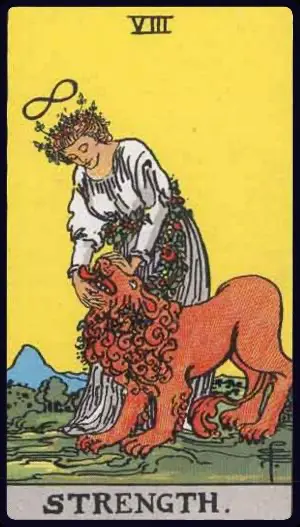
The warrior energy of The Chariot eventually gives way to something subtler and more enduring. The Fool encounters Strength — not the brute force of armor and willpower, but the quiet courage of compassion. A woman in a white robe gently closes the jaws of a lion, not through force but through calm, patient love. Above her head floats the lemniscate — the same infinity symbol that appeared above The Magician — showing that this, too, is a form of infinite power.
Waite moved Strength from its traditional position at XI to VIII, aligning it with the zodiac sign Leo. This placement is significant: it tells us that true strength comes not after the hard lessons of later cards, but earlier in the journey — it is a foundational quality, not a culmination.
The Fool learns that the lion represents their own animal nature — the fears, desires, rages, and instincts that live within every person. These forces cannot be conquered through battle (that was The Chariot's approach). They can only be tamed through patience, self-compassion, and gentle persistence.
This card teaches The Fool that courage is not the absence of fear but the willingness to face it with an open heart. The strongest people are not those who fight the hardest, but those who can sit with discomfort, hold space for difficulty, and transform raw emotion into grace. The Fool carries this quiet power forward into the solitude that follows.
The Hermit
Card 10 of 22
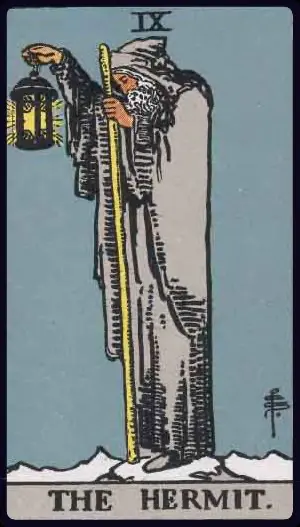
The Fool, now equipped with both outer achievement and inner strength, feels drawn away from the world and into solitude. They climb to a mountaintop and find The Hermit — an old man in a gray cloak standing alone at the summit, holding a staff in one hand and a lantern in the other. Inside the lantern shines a six-pointed star — the Seal of Solomon, representing the union of heaven and earth, the above and the below.
The Hermit's mountain represents the long, sometimes lonely climb toward self-knowledge. After all the external teachers (The Magician, The High Priestess, The Hierophant), The Fool must now become their own teacher. The Hermit says: "The answers you seek are already within you. But to hear them, you must withdraw from the noise of the world."
This is not the isolation of despair — it is the deliberate solitude of the seeker. The Hermit turns inward to contemplate the deeper questions of existence: Who am I? What truly matters? What is my unique purpose? The lantern represents the inner light of wisdom that guides the way when the external world grows dark.
The Fool learns the value of introspection, patience, and the willingness to walk alone when the journey demands it. The Hermit also carries a responsibility: having found the light, they must eventually return to the world and share it with others. But first, there is a great turning — the wheel is about to spin.
Wheel of Fortune
Card 11 of 22
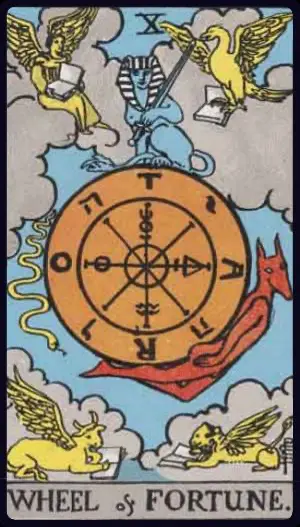
The Fool descends from the mountain and encounters something vast and impersonal: the Wheel of Fortune. A great wheel floats in the sky, inscribed with the letters T-A-R-O (which can also be read as ROTA, Latin for "wheel") and the four Hebrew letters Yod, Heh, Vav, Heh (the Tetragrammaton, the name of God). Three figures cling to the wheel: a serpent descends on the left (representing the descent into the material world), Anubis rises on the right (representing the ascent to consciousness), and a sphinx with a sword sits motionless at the top (representing the equilibrium of understanding).
In the four corners, the four fixed signs of the zodiac — the angel (Aquarius), the eagle (Scorpio), the lion (Leo), and the bull (Taurus) — each read from a book, representing the laws of the universe that exist beyond the wheel's turning.
The Fool confronts a humbling truth: not everything in life is within personal control. The wheel turns, fortunes rise and fall, and cycles of growth and decline are woven into the fabric of existence. The Fool's journey has reached a midpoint — a moment of reckoning with fate, karma, and the larger forces that shape life.
The lesson is not fatalism, but perspective. What goes up will come down, and what is down may rise again. The wise soul does not cling to the wheel in desperation but learns to find their center — the still point around which everything revolves. From this place of acceptance, The Fool is ready to face questions of justice and fairness.
Justice
Card 12 of 22
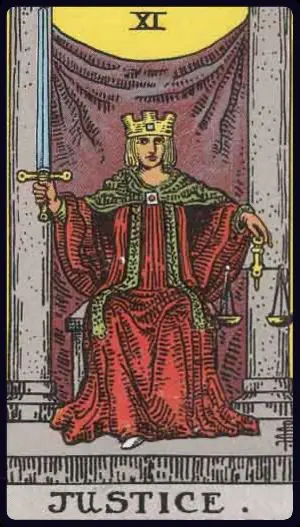
After confronting the impersonal turning of fate, The Fool seeks meaning and fairness — and encounters Justice. A crowned figure sits on a throne between two gray pillars (echoing The High Priestess), holding a raised double-edged sword in the right hand and perfectly balanced scales in the left. A red robe represents passion; a green cloak represents growth.
Waite moved Justice from its traditional position at VIII to XI, placing it after the Wheel of Fortune to align with Libra, the sign of balance and fairness. This placement carries thematic weight: after experiencing how fortune rises and falls randomly, The Fool now confronts the law of cause and effect. Justice says: the wheel may spin in ways beyond your control, but your actions still have consequences.
Justice is not about punishment — it is about truth. The double-edged sword cuts through illusion, demanding honesty with oneself and others. The scales insist on balance: every action produces a reaction, and ultimately, accounts must be settled.
The Fool learns accountability. The choices made at The Lovers, the drive of The Chariot, the solitude of The Hermit — all of these had consequences, and Justice asks The Fool to face them squarely. This card teaches that true fairness begins with self-honesty. Only by acknowledging the full truth of one's actions can The Fool move forward with integrity. And the next step requires the most radical honesty yet: the willingness to surrender.
The Hanged Man
Card 13 of 22
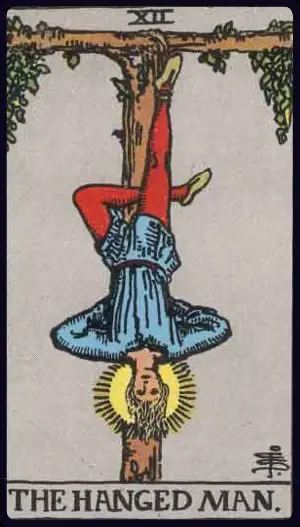
Something unexpected happens. The Fool, having charged through life with willpower (The Chariot), gentleness (Strength), wisdom (The Hermit), and accountability (Justice), now finds themselves… suspended. The Hanged Man hangs upside down from a T-shaped cross made of living wood, one leg bent to form a triangle behind the other. Yet his face is calm, even peaceful, surrounded by a golden halo. His hands are clasped behind his back.
This is not a punishment — it is a voluntary sacrifice. The Hanged Man has chosen to see the world from an entirely different perspective. Everything is reversed: what was up is now down, what was certain is now questioned, what seemed important may now seem trivial.
The Fool learns the transformative power of surrender. After all the effort of the first half of the journey — building, achieving, conquering — The Hanged Man says: "Stop. Let go. Give up control." In this suspended state, freed from the need to act and achieve, The Fool discovers truths that were invisible from the right-side-up position.
This is the card of sacred pause, of creative incubation, of the mystic who gains enlightenment through apparent foolishness. The living wood of the cross shows that even in this state of suspension, growth continues. The Hanged Man teaches that sometimes the bravest thing is not to push forward but to stop, wait, and trust the process. The golden halo confirms: this surrender leads to illumination, not defeat. But what follows surrender is the most feared card in the deck.
Death
Card 14 of 22
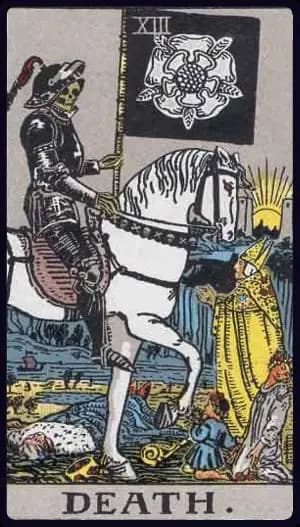
The Fool now faces the card that frightens almost everyone at first glance: Death. A skeleton in black armor rides a white horse, carrying a black banner emblazoned with a white five-petaled rose — the Mystic Rose, an ancient symbol of life and rebirth. Before the rider, a king has fallen, a bishop stands in prayer, and a young woman and child kneel — showing that Death comes for all, regardless of status. In the background, the sun rises between two towers.
The sun is rising, not setting. This is the key to understanding Death in the tarot: it is not the end. It is transformation. Every caterpillar must dissolve within the cocoon before becoming a butterfly. Every old self must be released before a new self can emerge.
The Fool, who surrendered control through The Hanged Man, now faces the ultimate release: the death of an old identity, an old way of being, an old chapter of life. This is frightening because it is real — something genuinely ends here. Relationships, beliefs, habits, or entire phases of life must be let go.
But the white rose on the black banner promises that life persists through transformation. The five petals represent the five stages of life, the five elements, the five senses — all continuing beyond this transition. The Fool learns that clinging to what has ended only prolongs suffering. True courage is the willingness to let the old die so the new can be born. And what emerges on the other side is something beautiful: balance.
Temperance
Card 15 of 22
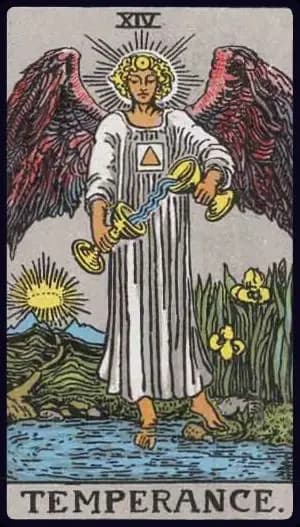
After the profound transformation of Death, The Fool encounters Temperance — a luminous angel with radiant wings standing with one foot on land and one in the water, gently pouring liquid between two cups. The liquid flows upward between the cups, defying gravity — showing that this is no ordinary mixing, but an alchemical process of integration. A winding golden path leads from the water into distant mountains, where a crown of light glows above the peaks. A triangle within a square is inscribed on the angel's robe, representing spirit contained within matter.
Temperance is the great healer of the journey. After the upheaval of Death, this card restores balance, harmony, and wholeness. The angel mixes opposing elements with patience and precision — fire and water, conscious and unconscious, spirit and matter. Nothing is rejected; everything is integrated.
The Fool learns the art of moderation, patience, and the middle way. After the extremes of the journey so far — the wild ambition of The Chariot, the total surrender of The Hanged Man, the radical transformation of Death — Temperance teaches that the most sustainable path is one of balance. No element should dominate; all parts of the self must work in harmony.
The golden path winding into the mountains suggests that this integration leads somewhere — toward a higher state of being. But the path is long, and the golden crown atop the mountains is still distant. The Fool has been purified through this process, but a great test still waits: the encounter with their own shadow.
The Devil
Card 16 of 22

Just when The Fool feels balanced and healed, The Devil appears — a great winged creature crouching on a black pedestal, inspired by Éliphas Lévi's famous illustration of Baphomet. One hand is raised. An inverted pentagram glows above the creature's head. Below, a naked man and woman stand chained to the pedestal by loose chains around their necks. The chains are large enough to slip over their heads — if they chose to.
That last detail is everything. The Devil does not represent some external force of evil. It represents the chains we forge for ourselves: addiction, materialism, unhealthy attachments, fear-based thinking, destructive patterns we maintain even when we know they harm us. The bondage is voluntary, even if it doesn't feel that way.
The Fool is confronted with their own shadow — the parts of themselves they have been avoiding, repressing, or feeding unconsciously. The desires they pretend not to have. The fears that drive behavior from behind the scenes. The comforting lies that keep genuine growth at bay.
This encounter is necessary. The Fool cannot achieve true wholeness without acknowledging and integrating the shadow. The Devil's lesson is uncomfortable but liberating: awareness is the first step toward freedom. Once you see your chains clearly, you can choose to remove them. The Fool must make that choice — to face the truth of their bondage and take responsibility for it. But breaking free from illusion can be explosive, and what follows is devastating.
The Tower
Card 17 of 22
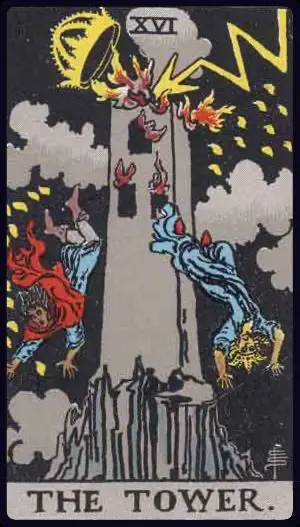
The moment of reckoning arrives with a thunderclap. The Tower — a tall stone structure built on a rocky peak — is struck by a bolt of lightning, blasting the golden crown (false authority, the ego's constructions) from its top. Flames burst from the windows. Two figures fall headfirst toward the jagged rocks below in postures of shock and despair. Twenty-two sparks rain down from the dark sky — one for each letter of the Hebrew alphabet and each card of the Major Arcana itself.
If Death was a transformation that rebuilt, The Tower is a destruction that clears the ground entirely. The structures The Fool built on false foundations — beliefs based on ego, relationships based on lies, identities based on fear — are shattered in an instant. Lightning represents sudden revelation: the truth that arrives whether you are ready for it or not.
The Tower is often feared, but it is ultimately an act of liberation. The structures that fall were never stable — they were built on the illusions The Devil exposed. Their destruction, while painful, is necessary. You cannot build something genuine on a false foundation.
The Fool learns that sometimes life must be broken open before it can be reassembled in a truer form. Crisis, while excruciating, can be the catalyst for the most profound growth. The crown that falls is the ego's pretension to permanence and control. With it gone, something beautiful becomes visible: the light of the stars above.
The Star
Card 18 of 22

After the devastation of The Tower, The Fool is stripped raw — vulnerable, shaken, but open in a way they have never been before. And there, in the calm night sky above the rubble, shines The Star. A nude woman kneels at the edge of a pool, pouring water from two jugs — one onto the land (the conscious world) and one into the water (the subconscious). Above her shines one large eight-pointed star surrounded by seven smaller stars. A bird perches in a tree behind her. The landscape is peaceful and expansive.
After destruction comes renewal. The Star is the card of hope — not naive optimism, but the deep, quiet faith that endures even after everything has been lost. The woman is completely naked and unashamed, representing total vulnerability and transparency. She has nothing to hide because there is nothing left to protect.
The eight-pointed star above is sometimes associated with Venus, the planet of love and beauty, or with the concept of cosmic equilibrium. The seven smaller stars may represent the seven chakras or the seven classical planets. Together they form a canopy of guidance — a reminder that even in the darkest moments, there are lights to navigate by.
The Fool learns that hope is not a reward for suffering but a birthright of the human spirit. After The Tower strips away everything false, The Star reveals what was always there underneath: a serene, authentic self, connected to something larger. The Fool begins to heal. But the journey is not over. Deeper mysteries await in the darkness.
The Moon
Card 19 of 22
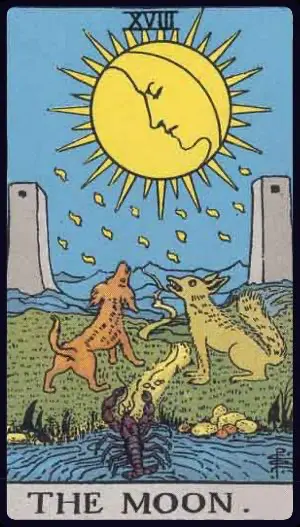
Guided by The Star's hope, The Fool enters a strange and unsettling landscape. A full moon hangs in the sky, containing a smaller crescent within it — the moon within the moon, suggesting layers of reality hidden within what we see. Below, a narrow path winds between two towers and stretches into mysterious mountains beyond. A crayfish crawls out of a pool of water in the foreground, an ancient symbol of emerging consciousness. On either side of the path, a dog and a wolf howl upward at the moon — one tamed, one wild, representing the domesticated and primal aspects of the mind.
The Moon is the card of the subconscious, of dreams, illusions, fears, and the unknown. After the clarity of previous cards, The Fool now enters a realm where nothing is quite what it seems. Shadows shift. Anxieties surface. The path ahead is visible but uncertain, and the light of the moon — unlike the sun — does not reveal everything. It illuminates just enough to suggest shapes and possibilities, many of which may be projections of The Fool's own fears.
The Fool must walk through this darkness without the comfort of certainty. The Moon asks: can you navigate by intuition when logic fails? Can you tolerate ambiguity? Can you keep moving when you cannot see clearly?
This passage through the unconscious is frightening but necessary. The Fool confronts illusions — about themselves, about the world — and learns to distinguish between what is real and what is a shadow of fear. The crayfish emerging from the water represents the oldest, most primitive parts of the psyche surfacing at last. By facing these depths, The Fool earns passage to the light that waits ahead.
The Sun
Card 20 of 22
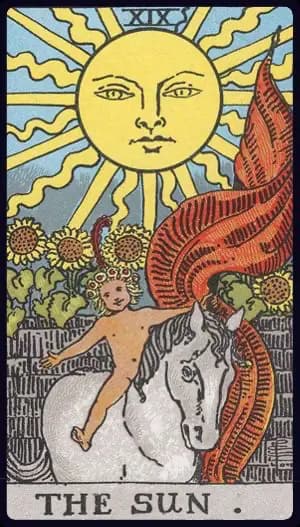
After the dark passage of The Moon, The Fool emerges into brilliant, unmistakable light. The Sun blazes in a clear sky — a great radiant face beaming down with warmth and clarity. Below, a joyful naked child rides a white horse with arms outstretched in pure celebration, wearing a crown of flowers and holding a red banner of vitality. Four tall sunflowers bloom behind a stone wall, turning their faces toward the light.
After all the complexity, ambiguity, and darkness of the journey's second half — The Tower's destruction, The Star's quiet hope, The Moon's confusing depths — The Sun is breathtakingly simple: joy. Pure, unfiltered, childlike happiness. The naked child represents the return to innocence — not the naive innocence of The Fool at the beginning of the journey, but the earned innocence of someone who has faced the darkness and emerged whole.
The white horse represents purified animal nature — The Fool's instincts, once symbolized by the fearsome lion of Strength, are now tamed and free, a joyful companion rather than an adversary. The stone wall suggests that even in this paradise, structure and boundaries exist, but they are not constraints — they are containers for growth.
The Fool is, for the first time since the journey began, truly happy. Not the thrill of The Chariot's victory, not the peace of The Hermit's contemplation, but genuine, radiant well-being. The Sun teaches that after every dark night, the light returns. And it was always going to. The penultimate stop on the journey calls.
Judgement
Card 21 of 22
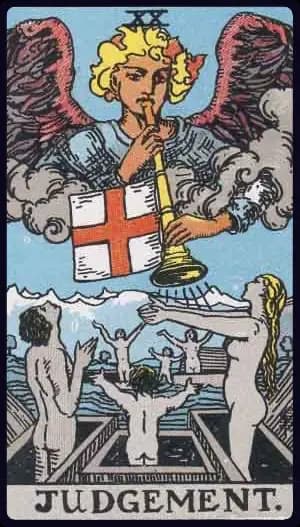
From the radiance of The Sun, The Fool hears a trumpet call echoing across the world. The archangel Gabriel blows a great horn from silvery clouds, a banner bearing a red cross on white cascading from the instrument. Below, figures rise from coffins — men, women, and children, arms outstretched toward the sky, their gray flesh taking on the color of life once more. Snowy mountains form the backdrop, representing the dividing line between the earthly realm and what lies beyond.
This is not punishment. This is resurrection — the call to awaken, to rise above the earthly story, and to be reborn into a higher understanding. Judgement represents the moment when The Fool reviews the entire journey — every lesson, every trial, every joy, every loss — and integrates them into a coherent understanding of who they truly are.
The Fool is being asked: Who have you become? What have you learned? Can you forgive yourself for the mistakes? Can you honor the growth? The figures rising from the coffins represent different aspects of the self — past selves, lost selves, forgotten selves — all being called back and made whole.
Judgement teaches that self-reflection is not self-judgment. The call of the trumpet is not an accusation but an invitation: wake up. See yourself clearly. Honor the journey. And prepare for what comes next — the final card, the destination that has been calling since the very first step off that cliff.
The World
Card 22 of 22
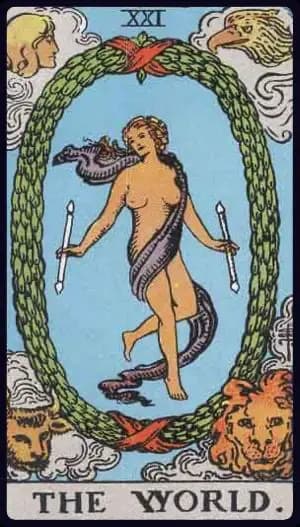
The Fool arrives, at last, at The World — the final card of the Major Arcana. A dancing figure, wrapped in a flowing violet scarf, holds a wand in each hand while floating inside a great laurel wreath. The wreath — a symbol of victory and completion since ancient times — is bound at the top and bottom by red ribbons forming lemniscates (infinity symbols), echoing the same symbol that appeared above The Magician at the journey's beginning. In the four corners sit the same four figures from the Wheel of Fortune — the angel, the eagle, the lion, and the bull — representing the four fixed signs of the zodiac, the four evangelists, and the four elements, now in perfect harmony.
The World is the card of completion, integration, and wholeness. Everything The Fool experienced across all 21 encounters — power, intuition, love, structure, choice, triumph, patience, wisdom, fate, justice, surrender, death, balance, shadow, destruction, hope, fear, joy, and rebirth — has been woven into a single, dancing, whole being.
The dancing figure is androgynous, suggesting the union of all opposites: masculine and feminine, conscious and unconscious, spirit and matter. The two wands echo The Magician's gesture — but where The Magician channeled energy between heaven and earth, The World dancer holds it all in perfect, dynamic balance.
This is not a static ending. The World dances — movement within completion, joy within fulfillment, the knowledge that every ending is also a beginning. The wreath forms an oval, sometimes likened to a cosmic egg, from which the next cycle will emerge.
And so The Fool, transformed beyond recognition from the innocent who stepped off the cliff, stands at the threshold once again. The journey is complete — but the soul is eternal. The wheel turns. The Fool takes a breath, adjusts their knapsack, and steps forward. The journey begins anew.
The Journey Never Ends
The Fool's Journey is not a one-time event. We cycle through these archetypal stages many times throughout our lives — in relationships, careers, creative projects, and spiritual growth. Each time we return to The Fool, we bring the wisdom of every previous journey with us. The cards are a mirror: they reflect where you are, where you have been, and where you might go next.