
The Rider-Waite-Smith Deck
The Creators
The Rider-Waite-Smith tarot deck (often abbreviated RWS) was first published in December 1909 by William Rider & Son of London. It was born from the collaboration of two members of the Hermetic Order of the Golden Dawn:
Arthur Edward Waite (1857–1942)
A British-American poet, scholar, and mystic who designed the conceptual framework for the deck. Waite was a prolific writer on Western esotericism, Freemasonry, Kabbalah, and ceremonial magic. He authored the deck's companion volume, The Key to the Tarot (1909), later expanded as The Pictorial Key to the Tarot (1911), which remains one of the most widely read tarot guides.
Pamela Colman Smith (1878–1951)
A British artist, writer, and occultist who illustrated all 78 cards. Smith was a talented artist with a background in theater set design, folklore illustration, and storytelling. Her ability to translate abstract mystical concepts into vivid, narrative scenes is what made the deck so accessible and enduring. Contemporary tarot readers increasingly refer to the deck as the "Smith-Waite" or "Waite-Smith" deck to properly credit her contribution.
What Made It Revolutionary
Before the RWS deck, most tarot decks — including the widely used Tarot of Marseilles — featured fully illustrated Major Arcana (trump cards), but represented the Minor Arcana with simple pip patterns: for example, the Three of Swords would show three swords arranged in a pattern, with no figures or narrative scene. The medieval Sola Busca tarot (1491) was a rare exception with fully illustrated Minor Arcana, and it likely served as inspiration for Smith's work.
Pamela Colman Smith's illustrations gave every one of the 78 cards a distinct human scene, rich with emotional and narrative detail. This meant that even a complete beginner could look at a card and intuitively grasp its meaning through the visual story being told. This single innovation is largely responsible for making tarot accessible to the general public and establishing the RWS as the standard reference deck.
Key Innovations
Waite introduced several deliberate changes to the traditional tarot structure, guided by the astrological and Kabbalistic correspondences taught by the Golden Dawn:
- Strength and Justice Swap: Waite repositioned Strength from its traditional position at XI to VIII, and Justice from VIII to XI. This aligned Strength with the zodiac sign Leo and Justice with Libra, matching the Golden Dawn's astrological correspondences.
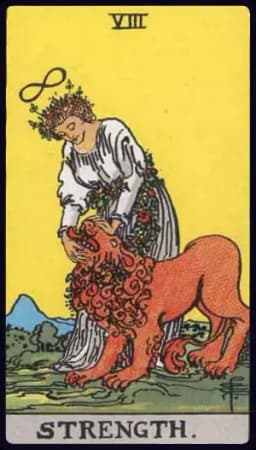
VIII — Strength
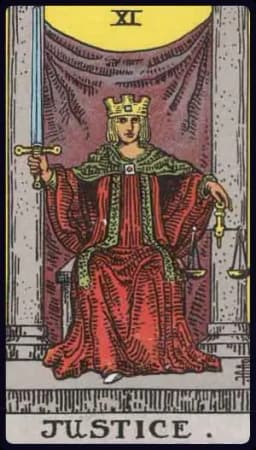
XI — Justice
- Narrative Minor Arcana: Every numbered card in the Minor Arcana received a unique scenic illustration, transforming abstract pip cards into accessible visual stories.
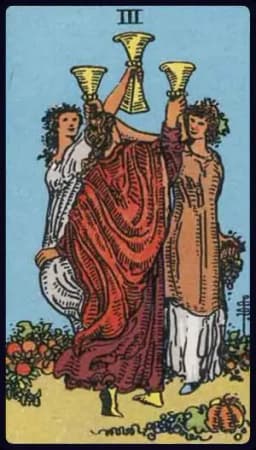
3 of Cups
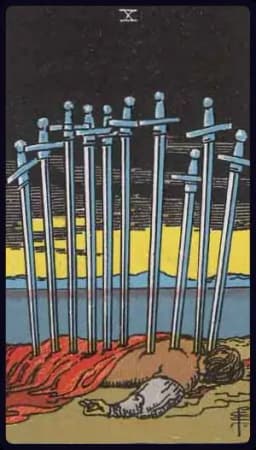
10 of Swords
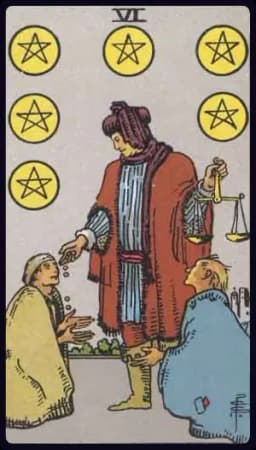
6 of Pentacles
- Blended Christian & Esoteric Imagery: Christian imagery was both added and removed. The "Popess" became The High Priestess (removing the Papal tiara). The Lovers card was redesigned to depict Adam and Eve in the Garden of Eden. The Ace of Cups features a dove carrying sacramental bread.
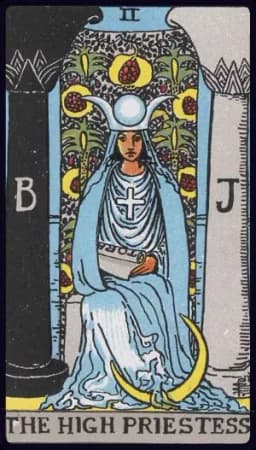
High Priestess
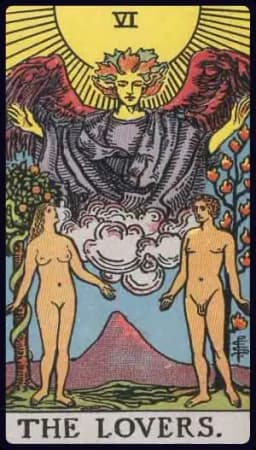
The Lovers
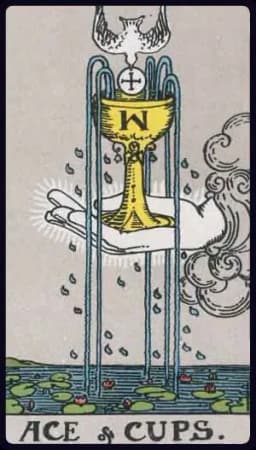
Ace of Cups
- Éliphas Lévi's Influence: The deck's symbolic language was deeply influenced by the 19th-century French occultist Éliphas Lévi, particularly in cards like The Chariot (with its sphinx imagery) and The Devil (based on Lévi's famous drawing of Baphomet).
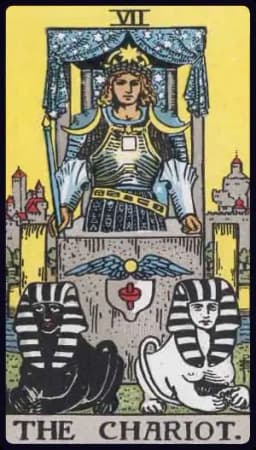
The Chariot
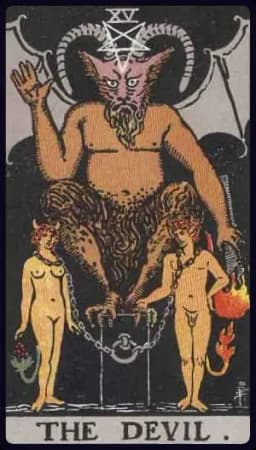
The Devil
Symbolism & Visual Language
The RWS deck uses a consistent symbolic vocabulary throughout its 78 cards. Learning to recognize these recurring symbols will deepen your readings:
Colors
- Yellow / Gold — Intellect, consciousness, solar energy
- Blue — The subconscious, intuition, depth
- Red — Passion, desire, action, life force
- White — Purity, spirituality, truth
- Gray — Wisdom, neutrality, detachment
- Green — Growth, fertility, nature
Recurring Symbols
- Mountains — Challenges, achievement, higher knowledge
- Water — The subconscious, emotions, flow
- Roses — Desire, passion, beauty
- Lilies — Purity, innocence, devotion
- Lemniscate (∞) — Infinity, eternal cycles, mastery (appears above The Magician and on Strength)
- Pillars — Duality, thresholds, the balance between opposites
The Four Suits
The RWS deck organizes its 56 Minor Arcana into four suits, each associated with an element and a domain of human experience:
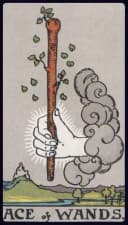
Wands — Fire
Creativity, willpower, ambition, and spiritual energy. Corresponds to Clubs in modern playing cards.
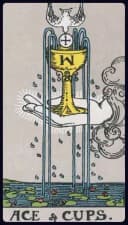
Cups — Water
Emotions, relationships, intuition, and the inner world. Corresponds to Hearts in modern playing cards.
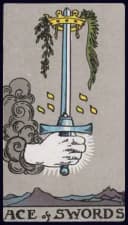
Swords — Air
Intellect, conflict, truth, and mental challenges. Corresponds to Spades in modern playing cards.
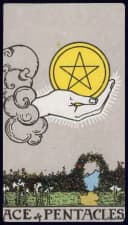
Pentacles — Earth
Material world, career, finances, and physical health. Corresponds to Diamonds in modern playing cards.
Court Cards
Each suit contains four court cards that represent personality types, developmental stages, or actual people in your life:
- Page — The student or messenger. Represents curiosity, new beginnings in the suit's domain, or a young person bringing news.
- Knight — The quester. Represents action, movement, and the passionate pursuit of the suit's energy. Knights can indicate extremes — either driven and focused, or reckless and impatient.
- Queen — The nurturer and master. Represents inward mastery of the suit's element — emotional depth, creative confidence, intellectual clarity, or material wisdom.
- King — The authority and leader. Represents outward mastery and the ability to direct the suit's energy in the world — leadership, control, and mature expression.
Influence & Legacy
The Rider-Waite-Smith deck has had an unmatched impact on tarot. Estimates suggest over 100 million copies have been sold across more than 20 countries, making it the most widely distributed tarot deck in history. Its imagery has become the de facto reference point — when people think of "a tarot card," they almost always picture Smith's illustrations.
The original 1909 artwork entered the public domain in the United States in 1966 (after the expiration of the initial 28-year copyright and its 28-year renewal). It is also in the public domain in the United Kingdom and all countries with a copyright term of 70 years or fewer after the death of the last co-author. This accessible copyright status has enabled thousands of derivative decks, recolorings, and reimaginings.
Despite the emergence of countless alternative decks, the RWS remains the recommended starting point for beginners. Its clear, intuitive imagery and the wealth of educational material built around it make it the ideal foundation for learning tarot.